That morning, as the young man went down the mountain to buy lamp oil,
a middleaged man sketching on the porch of a small shop called out:
“Could you sit for me a moment?
I’m practicing portrait drawing.”
The young man was surprised, but agreed.
He sat on a wooden chair, hands resting lightly on his knees, gazing into the distance.
The artist lifted his pencil and began sketching.
The air was quiet except for the soft scratching of graphite on paper.
After a while, the artist handed him the sketch.
“Here, take a look.”
The young man looked at the drawing.
It was his face—
but not him.
A face slightly stern, slightly distant, slightly burdened.
A face carrying an old story.
He stared at it for a long moment.
Then he laughed softly:
“This… is not me.”
The artist frowned.
“But I drew exactly what I saw.”
The young man nodded.
“Yes.
But that is only an image.
Not who I truly am right now.”
The artist was silent for a moment, then smiled.
“You’re right.
An image is only a slice.
Not the whole.”
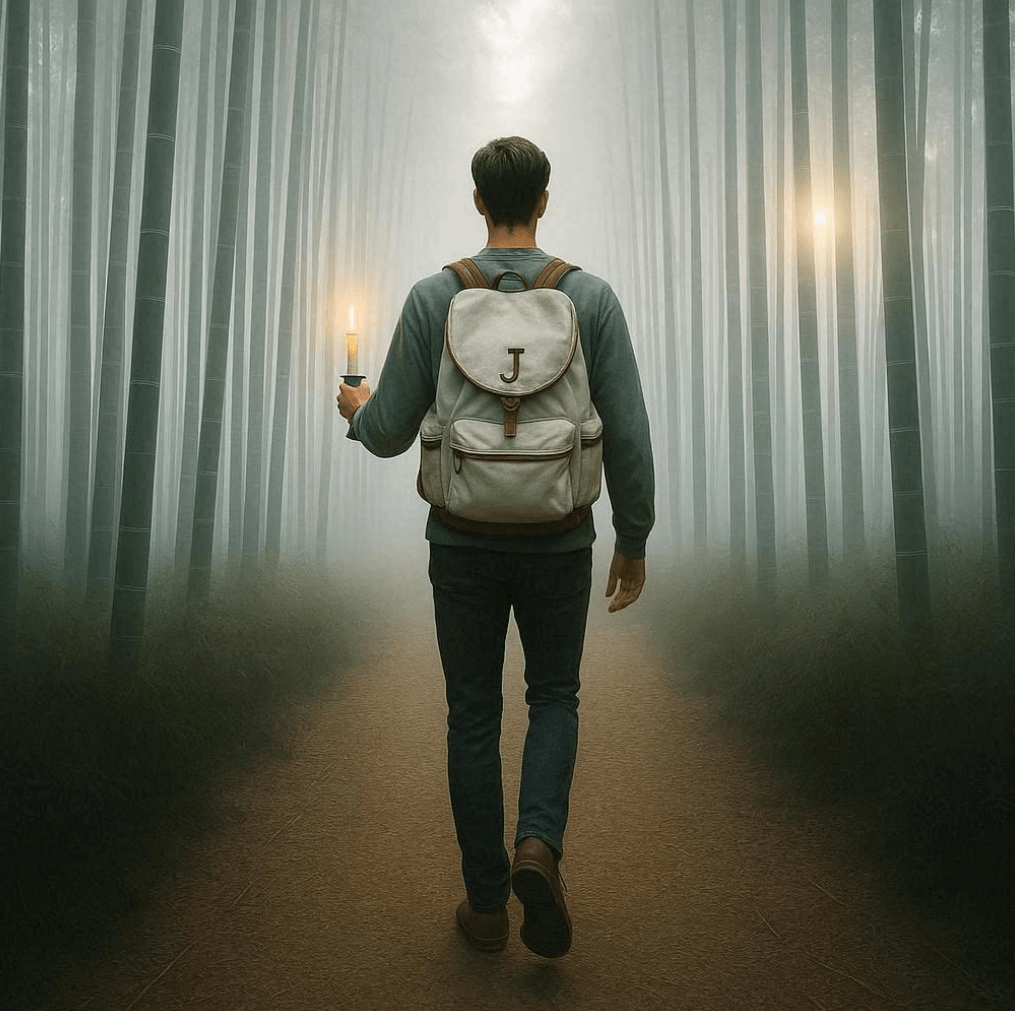
The young man thanked him and walked back up the mountain.
On the way, he felt clearly:
He had lived his whole life according to invisible portraits of himself—
images created by others,
by the past,
by his own mind.
The teacher was sitting under the bodhi tree when he returned.
He looked at the young man, as if he already knew.
“What are you seeing?”
The young man held up the sketch.
“This image is not me.
And I suddenly realized:
I’ve been living according to images like this—
images that are not me.”
The teacher smiled.
“Good.
Today you’ve seen:
the image of yourself is not yourself.”
1. Jiddu Krishnamurti: Images are the greatest burden
The teacher said:
“Jiddu Krishnamurti taught that each person carries countless images of themselves:
· images created by parents
· images created by society
· images created by success
· images created by failure
· images created by the past
· images created by desire
But an image is never the truth.
It is only a dead picture.
You, on the other hand,
are a living stream changing every moment.”
The young man looked at the sketch—
it was still,
while he was breathing, living, changing.
2. Avatamsaka: No fixed entity to form an image
The teacher continued:
“The Avatamsaka teaching says all phenomena lack inherent nature.
There is no fixed entity called ‘self.’
If there is no fixed entity,
what are these images based on?
An image is only a layer of paint over a flowing river.
But the river never stays still long enough to be painted.”
The young man felt something lighten—
as if he had removed an invisible mask.
3. When you are free from selfimage…
The teacher said:
“You no longer need to become someone.
No longer need to protect your reputation.
No longer fear judgment.
No longer live according to others’ expectations.
No longer play a role.
You become natural:
like flowing water,
like blowing wind,
like spreading light.”
The young man smiled—
a smile soft as a falling petal.
4. Jiddu Krishnamurti meets Avatamsaka: Life has no fixed shape
The teacher said:
“Jiddu Krishnamurti helps you see that images are burdens.
Avatamsaka helps you see there is no fixed self to create images.
When the two meet, you see clearly:
Life has no fixed shape.
Only images do.
When you live as life itself,
you are free.”
5. Practice: release the image — return to life
The teacher said:
“From today, whenever the mind creates an image of ‘you,’
simply say:
‘The image is not me.’
No fixing.
No resisting.
No believing.
No performing.
Just return to the life unfolding now.”
The young man placed the sketch on the stone table outside the hermitage.
A breeze blew, making the paper tremble—
as if it too wanted to fly away.
The image may remain,
but he was no longer trapped inside it.


Bình luận về bài viết này