Introduction: The Digital Economy and Its Invisible Shackles
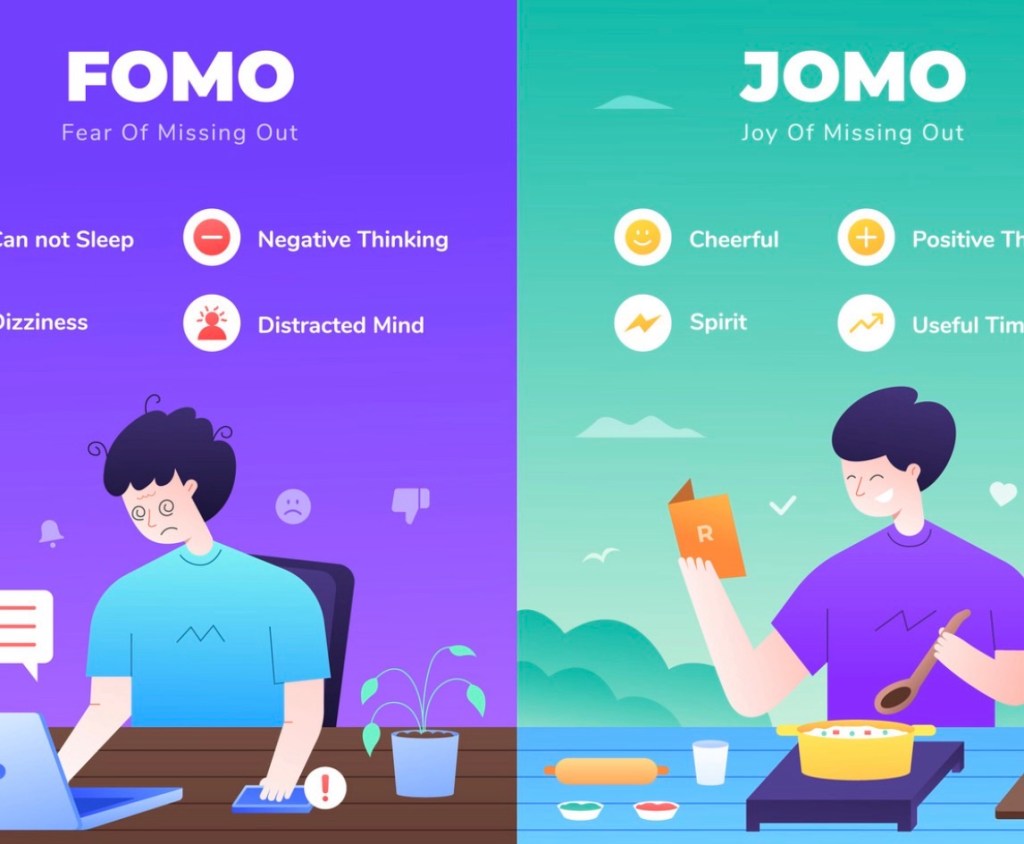
In the relentless torrent of the digital age, modern humans believe they master technology, yet they are profoundly shaped by it. Social media algorithms do not just optimize our viewing experiences; they optimize human psychology and behavior. Unconsciously, we are dragged into a generational syndrome known as FOMO (Fear Of Missing Out). FOMO compels us to constantly connect, continuously update, and perpetually measure our self-worth against the curated glitz on flat screens. It turns humans into passive, reactive bystanders of their external circumstances, frantically chasing trends to fill an inner void.
To resist this merciless pull, a new philosophy of life emerged like a breath of fresh air for a suffocated spirit: JOMO (Joy Of Missing Out). JOMO manifests with a wholesome veneer, guiding individuals toward intentional digital detoxes, rejecting shallow connections, and establishing healthy personal boundaries. People expected JOMO to be a sophisticated shield, a perfect counterweight allowing everyone to reclaim their time and energy to build a “sanctuary of peace” for themselves.
However, can JOMO truly salvage humanity from digital manipulation? Looking deeper into reality, we confront a startling revelation: this is an unequal battle. This essay dissects the profound layers of this paradox, tracing it from the commercialization of spiritual values to the intrinsic nature of self-liberation.
1. The Core of the Battle: When “Panic” Masquerades as “Peace”
To understand why fighting FOMO with JOMO is an unequal battle, one must first expose the systemic nature of the modern economy. Commercial empires build their fortunes by fully exploiting Maslow’s Hierarchy of Needs. When consumers grow weary and depleted at the lower echelons (material consumption and FOMO-driven entertainment), marketers instantly upgrade their products to the higher tiers: the need for self-expression and inner peace.
This is precisely where JOMO gets sucked into the commercial machine. The trend-driven versions of both FOMO and JOMO stem from the exact same root: existential panic and the ego’s thirst for gratification.
- FOMO is the fear of being left behind, the anxiety of failing to match others in material wealth and social experiences.
- JOMO (in its superficial form) is actually the fear of facing the loneliness, emptiness, and dark corners of one’s own mind when disconnected from the internet. To escape this fear, individuals hastily drape themselves in the mantle of “mindfulness” and “healing” to reassure themselves and perform for the crowd.
A social trend is inherently a sweeping flood. When you attempt to build your sanctuary of peace out of “JOMO products”—such as aesthetic linen clothing, expensive tea ceremony sets, or branded “healing” retreats—your home is merely a crystalline structure: shiny on the outside but hollow within. Because it is built on the seeds of attachment and trend-chasing, this crystal structure is extremely fragile. The moment the trend shifts or an individual’s financial and mental resources run dry, this illusion of peace shatters instantly.
2. The Dark Side of Superficial JOMO: The Tragedy of “Livestreaming Stillness”
A major hazard for contemporary JOMO practitioners—and a golden opportunity for profit-driven empires—is turning an internal practice into superficial packaging. This phenomenon runs rampant across social media via the “mindful living” wave:
- Dependency on Guides: It is true that when something is new and profound, we must learn and observe those who walked before us. However, lifestyle corporations intentionally engineer tiers of enlightenment, offering courses from basic to advanced to retain practitioners as long as possible. Instead of achieving cognitive independence, we become dependent on a specific “guru” or “community.” We follow in their footsteps for so long that the self-reliant essence of JOMO is completely erased.
- The “Livestreaming Stillness” Syndrome: This is the pinnacle of irony. The original purpose of JOMO is to create a pause to return to oneself, to courageously open and read the “diary pages of one’s life,” looking back at experiences under an independent light to recognize mistakes and self-correct. Yet, in that very stillness, people turn on cameras and meticulously curate aesthetic angles to livestream their meditation or tea ceremonies just to farm views and likes.
When you need the external world to witness your “letting go,” you are not letting go at all; you have merely transitioned from flaunting material goods to flaunting your transcendence. Stillness is no longer a space for self-reflection; it becomes a piece of jewelry to position one’s personal brand. JOMO, in this state, is nothing more than glamorous packaging wrapping a product that is inherently FOMO.
3. The Philosophy of “The Raft to Cross the River” and “The Floating Shack on the Banks of FOMO”
In the history of human thought, the Buddha offered a classic teaching: His Dharma is like a raft to cross the river, meant to carry people from the shore of ignorance to the shore of enlightenment, not to be clung to. Looking broadly at how the “JOMO raft” is utilized today, we see a profound delusion regarding the means to an end.
The Buddha stated that the Dharma is like a raft to keep us from sinking into the waters, but he did not dictate “how to cross the river.” The answer lies entirely in self-reliance. To move a raft across a river, the individual must steer and row using their own muscle, sweat, and alertness. The teachings, or a JOMO lifestyle, are merely a supportive vehicle.
Furthermore, the Buddha never taught that we must gather into a crowd to cross the river together. When he achieved great enlightenment under the Bodhi tree, he was entirely alone, in absolute solitude with his own consciousness. Yet, today, people seek liberation but fear loneliness. They need a crowd to validate the trend and a community to feel they are “healing” correctly.
This attachment to form and crowd alters the very nature of JOMO. Instead of using JOMO as a temporary vehicle to push their raft to the other side—the shore of stability and self-mastery—people anchor the raft right where it is. Upon this raft, they erect a beautiful “floating shack” scented with candles and tea, sitting together to applaud each other’s peace. They forget that this floating shack is still staked directly into the river of FOMO. The water below is still rushing violently, and their position hasn’t shifted a single inch from the consumerist world outside. They are merely indulging in a self-satisfied illusion of peace they drew for themselves.
Conclusion: Activating Innate Energy—The Destination of True Autonomy
Using JOMO to “fight” FOMO is an unequal battle if we continue to misuse the tool and seek the wrong method. JOMO, or any mechanism born to resist external circumstances, is only a temporary vehicle. Just as we board a boat or a raft to reach another bank, or step onto a bridge to cross it, we are not meant to sit on the boat forever or stand on the bridge indefinitely. We must learn to “walk on our own” with “steadfastness” so that FOMO, JOMO, or any fear and desire can no longer rule over us.
JOMO is not the final destination; it is a technical pause, creating a temporary “sanctuary of peace” so we have enough time to stop and return to our own body and mind. Only when we dare to turn off all the stage lights of social media, practicing JOMO at the right time, in the right way, and without an audience, can the “wholesome innate energies”within us have the opportunity to mature.
Once that innate energy is grounded and strong, you step onto the shore and courageously leave the JOMO raft behind. You return to everyday life, facing social media and consumerism with absolute equanimity. You no longer feel the need to “resist” FOMO or chase JOMO, because at this point, you genuinely master yourself.
(JOMO vs FOMO)


Bình luận về bài viết này