INTRODUCTION
For Western readers exploring the profound depths of Eastern spirituality, the relationship between a spiritual seeker and a spiritual guide can often seem beautifully mystical yet difficult to navigate. This reflective essay invites you to sit quietly with a cup of tea and re-examine this dynamic through two timeless lenses: The Mahā Maṅgala Sutta (The Buddha’s Discourse on Blessings) and the evocative Zen poetry of Quach Thoai, a famous mid-20th-century Vietnamese poet.
By interweaving the ancient wisdom of the Dhamma with the silent beauty of Zen poetry, these humble reflections explore the true essence of spiritual “proximity.” It looks gently yet honestly at how modern practitioners sometimes misunderstand closeness as physical attachment or personal ego, and offers a path toward “Right View”—a sacred, mindful distance where self-cultivation and devotion truly merge into a genuine blessing.
1. THE ECHOING BELL FROM THE DISCOURSE ON BLESSINGS
In the realm of Vietnamese Zen poetry, the verses of Quach Thoai have deeply moved countless souls searching for true beauty:
“Standing still outside the hedge,
You smile your miraculous smile.
Gazing at you in sheer wonder,
I catch the faint sound of your singing—
Your song of eternity.
– I bow my head in deep reverence.”
That peony simply stands still outside the hedge, smiling and singing its eternal song. The poet does not step over the fence to pluck the flower, nor does he take it to his private room as a personal possession. He chooses to stand at just the right distance—a distance filled with wonder and reverence—to contemplate, to listen, and then to bow his head before that timeless beauty. How sacred and pure that distance is.
The relationship between a lay Buddhist and the monastic community, after all, requires a similarly sacred distance. In the life of a practitioner, perhaps everyone has at least once stilled their mind to listen to the verses of the Maha Mangala Sutta—the Discourse on Blessings. Among the thirty-eight blessings taught by the Buddha as ambrosia to soothe a hectic life, there is a verse that resonates as a north star for the relationship of supporting the Dhamma:
“Biết kiên trì phục thiện,
Thân cận giới xuất gia,
Dự pháp đàm học hỏi,
Là phước đức lớn nhất.”
(To be persevering and open to correction,
To associate with monastics,
To engage in religious discussions at due seasons,
This is the highest blessing.)
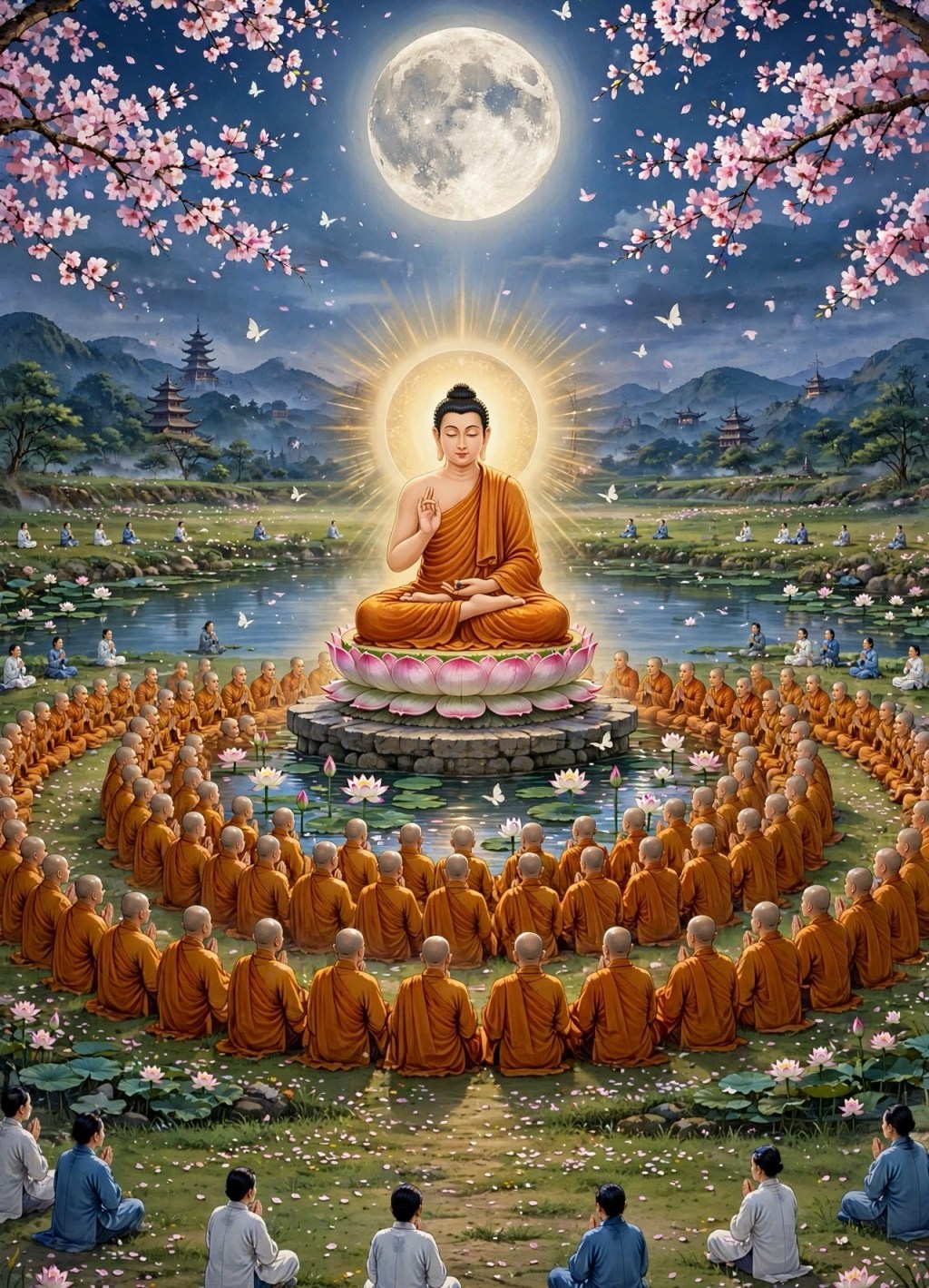
This teaching, from the very beginning, sowed a seed of pure faith in the hearts of temple-goers. The monastic community—those who have left the household life, vowing to walk the path of precepts, concentration, and wisdom—are the messengers of the Tathagata. They are the lighthouses illuminating the way home for souls still tossing on the shifting waves of worldly life. For a lay practitioner (Upasaka, Upasika) to seek spiritual guidance and take refuge under the shade of the Sangha is an entirely noble spiritual need. It is not only a duty but also a grand wholesome connection, an expression of deep respect for the Triple Gem.
However, worldly language is often a narrow garment for the transcendent thoughts of the Enlightened One. Through the vicissitudes of time, when these words enter practical life through the lens of the mundane mind, the phrase “to associate with” (or “to be in close proximity”) has inadvertently been misunderstood to some extent. From an inward-looking practice meant to restrain the mind, people have easily turned it into an outward form, becoming attached to external appearances and personal relationships.
The crude words written down here do not aim to criticize or judge the negative phenomena within monastic walls. Stemming from love and deep reverence for the True Dhamma, the writer merely wishes to sit down with the reader over a quiet cup of tea, turning back to the original teachings of the Buddha. From there, we may re-examine the boundaries of “proximity,” moving past the entanglements of words and practical distortions, to rediscover the path of Right View—where personal practice and supporting the Triple Gem truly merge into one, creating a genuine and untarnished blessing.
2. THE BUDDHA’S TEACHING – “PROXIMITY” MEANS CLOSENESS TO THE DHAMMA
To fully comprehend the peaceful energy within the teachings of the Blessed One, we must retrace the steps of time, returning the word “proximity” to its pristine scriptural context. In the Pali language of the original discourses, the concept of being close to noble ones is always associated with the pursuit of the Dhamma. The essence of an Upasaka or Upasika stepping into a monastery has never been about physical distance or mundane attachment. It is measured by spiritual distance and alignment in virtue.
The Buddha placed the phrase “To associate with monastics” right before “To engage in religious discussions.” This arrangement is by no means accidental; it is a highly systematic and rigorous process of spiritual cultivation. Drawing near to a genuine monastic is, first and foremost, an opportunity to hear the True Dhamma and discuss life’s entanglements with a teacher to unfold wisdom. The monastic is the guide walking ahead, holding the treasury of the Tathagata’s wisdom; the lay practitioner draws near to borrow the teacher’s torch to illuminate their own path.
Furthermore, proximity is also about learning through example. Laypeople live in the heart of society, facing thousands of worries, pursuits of fame, and the friction of human relationships every day. When stepping into a monastery, seeing a simple faded robe, a calm and mindful step, a gaze of compassion, and patient endurance in the face of adversity from a true practitioner, the mind naturally settles. This closeness nurtures wholesome seeds in consciousness, helping the practitioner reflect upon themselves to “persevere and be open to correction”—rectifying their own shortcomings and flaws.
The relationship between the monastic and lay communities, as taught by the Buddha, is a purely transcendent symbiotic relationship. The laypeople joyfully offer the four requisites (food, clothing, lodging, and medicine) to support the monastics so they can practice without worrying about their livelihood. Conversely, the monastics use their virtue and wisdom to provide spiritual guidance to the laypeople. It is the meeting of two pure minds, co-directed toward the ideal of liberation, leaving absolutely no room for calculations, fame, or personal emotional attachment. True proximity, therefore, is closeness in Dhamma and harmony in the aspiration for goodness.


Bình luận về bài viết này