THE MEANING BEHIND “PROXIMITY UNDER THE MOONLIGHT”
Someone once asked the writer: “Why choose the title ‘Proximity’ Under the Moonlight?” The answer lies not in poetic romance, but in a sacred historical memory from the time when the Blessed One was still in this world.
During the Buddha’s time of teaching, it was customary for the monastics to gather together after collecting alms and sharing their meal to distribute the food and discuss the Dhamma. These were internal, exclusive periods of cultivation reserved solely for the monastic community (Bhikkhus), with absolutely no presence of lay followers.
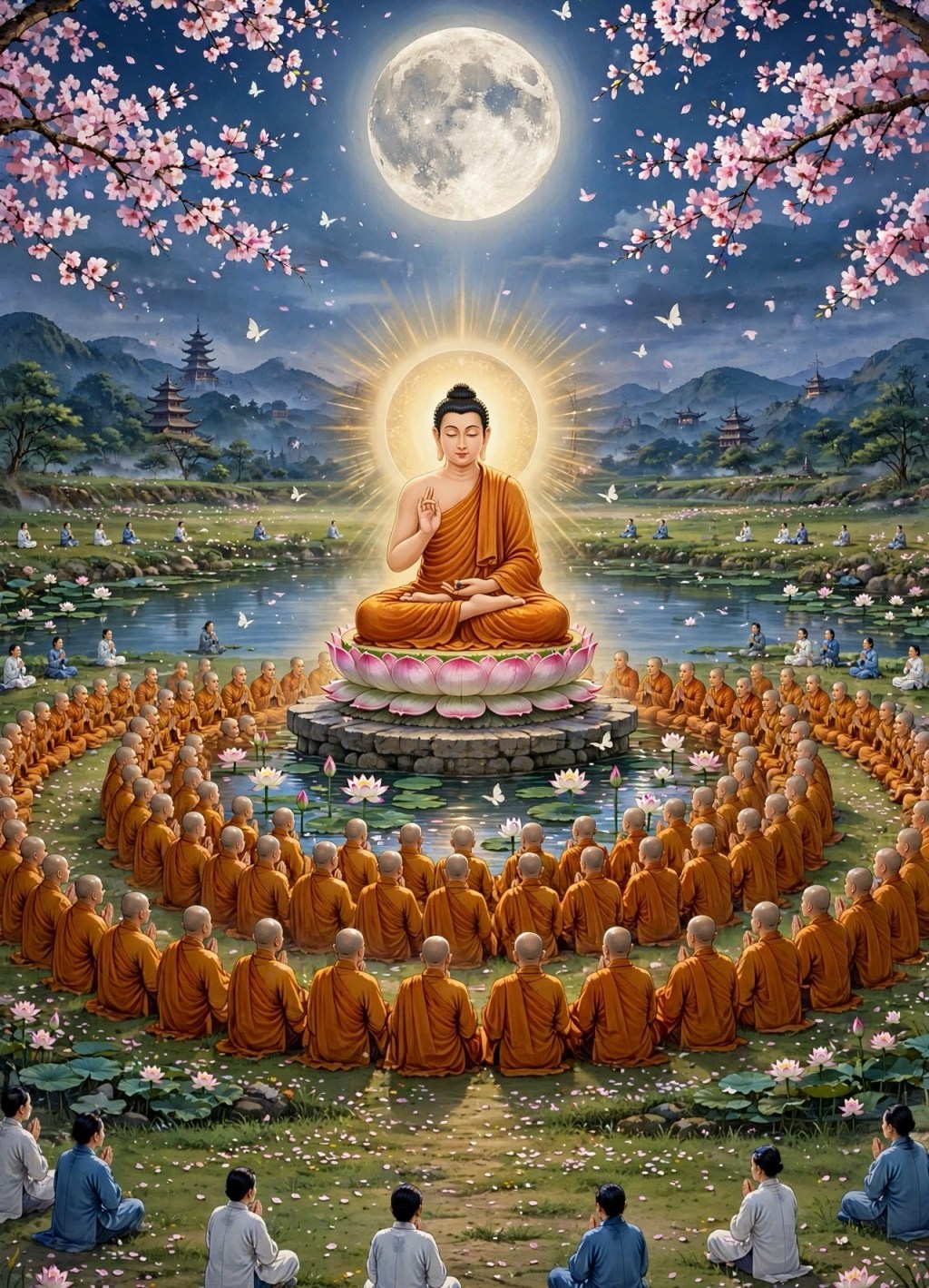
Laypeople of that era had only one unique opportunity to hear the Dhamma: on the nights of the bright moon. It was on these moonlit nights that open Dhamma assemblies were organized. These were sacred nights, much like the night when the householder Anathapindika traveled through the darkness, guided only by the light of virtue, to meet and listen to the Buddha’s teachings for the very first time.
However, within the space of these moonlit Dhamma assemblies, the gathering was immense, often consisting of thousands of people sitting in multiple concentric circles. The monastics sat in the inner circles, closest to the Buddha. The lay practitioners sat only in the peripheral circles on the outer edge. The title Upasaka (layman) or Upasika (laywoman), in its literal spatial sense, referred precisely to this seating position: they were those who sat on the outermost circle, directly adjacent to and close to the Bhikkhus.
In ancient times, when modern sound amplification devices did not exist, for thousands of people sitting far outside to hear clearly, the Buddha would speak a line of Dhamma, and the Bhikkhus in the inner circles would recite it in unison (re-chant) for the circles behind them, and so it was passed along to the outside. Thus, if a lay practitioner did not sit close to the monastics in the adjacent circle, they would be completely unable to hear and understand the True Dhamma. Drawing near to the monastics under the moonlight was, therefore, the minimum and only distance for the layperson to gather each drop of the refreshing Dhamma rain flowing from the golden mouth of the Compassionate Father.
That moonlight was cool and inclusive, yet it defined a clear, sacred boundary. The lay practitioner sat in the outer circle, receiving the torch of the Dhamma from those walking ahead, rather than pushing into the inner circle to disrupt the pure order of the Sangha.
And precisely because they sat on the periphery, the Buddha always contemplated their capacity to deliver teachings suitable for household life. This adaptability was beautiful, yet it carried its own boundaries, as shown in the touching story of the householder Anathapindika on his deathbed. When Venerable Sariputta and Venerable Ananda came to visit and delivered a profound discourse on letting go of the senses (The Discourse on the Advice to Anathapindika), the householder shed tears of happiness, yet with deep regret, he exclaimed: “Venerable Sir, I have served the Blessed One and the virtuous monastics for so many years, yet I have never heard a Dhamma discourse as profound as this.” Venerable Sariputta gently replied: “Householder, such deep discourses are meant for the monastics, not for laypeople.”
It turns out that from thousands of years ago, “proximity” was already a deeply humble seating position under the moonlight. The lay practitioner stands outside the spiritual hedge, receiving the portion of the Dhamma that fits their capacity to practice, maintaining a distance of reverence to respect the path of liberation of the monastics. “Proximity” Under the Moonlight is the ultimate symbol of a path of supporting the Dhamma: receiving the reflected light from the moon to ignite one’s own torch, illuminating one’s own path ahead./.
(The Season of the Bright Moon, 2026)


Bình luận về bài viết này