I. Introduction: A simple yet profound metaphor
Among the Buddha’s teachings, the image of the torch is one of the most beautiful.
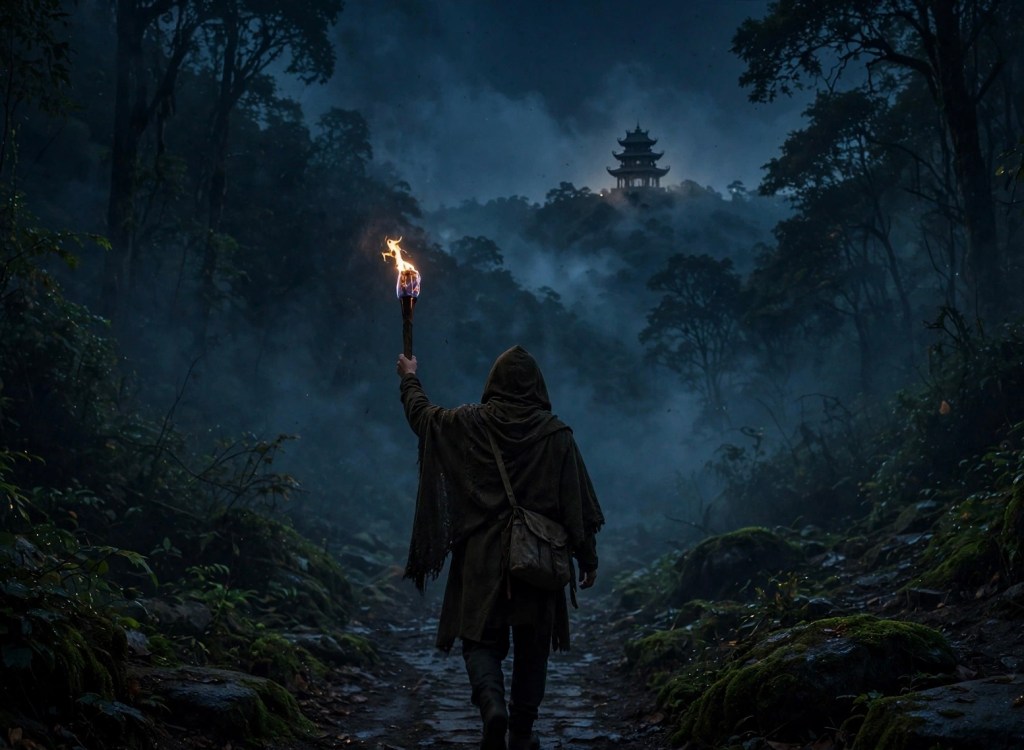
The Dharma is like a bright torch, but practitioners can only borrow its flame, not borrow its light.
This reveals a deep truth:
No one can live, see, understand, or awaken on your behalf.
—
II. What does “borrowing the flame” mean?
Borrowing the flame means:
• learning the Buddha’s words,
• listening to teachings,
• reading scriptures,
• receiving guidance from teachers,
• observing the experience of those ahead.
This is the initial light, preventing us from walking in darkness.
But this light is not ours, and cannot guide us forever.
Borrowing the flame is the beginning of skillful means.
—
III. What does “lighting your own torch” mean?
Lighting your own torch means:
• self‑observation,
• self‑experience,
• self‑verification,
• self‑transformation,
• seeing truth in your own life.
This is true light, because it arises from within you.
No one can take it away, and no one can give it to you.
This is the essence of self‑reliance in practice.
—
IV. Why you cannot walk with someone else’s light
1. Different karma and capacities
What helps others may not help you.
What others see clearly, you may not.
What others realize, you may not be ready to realize.
2. Experience cannot be fully transmitted
No one can give you:
• their clarity,
• their awakening,
• their peace.
They can point the way, but you must walk it.
3. Teachings are maps, not the path
Maps guide us, but cannot walk for us.
Studying the map without walking leads nowhere.
4. Borrowed light cannot break your ignorance
The Buddha’s words can illuminate part of the path,
but your ignorance must be broken by you alone.
No one can remove your ignorance for you.
—
V. The danger of relying only on borrowed flame
If one only borrows the flame, they may fall into:
• attachment to teachings,
• attachment to methods,
• attachment to teachers,
• attachment to rituals,
• attachment to dogma,
• attachment to “right vs wrong,”
• attachment to “orthodox vs unorthodox.”
Borrowed light becomes a wall, not a torch.
This is why the Buddha taught:
“Be a lamp unto yourselves.”
—
VI. Practical meaning for lay practitioners
For laypeople, this teaching is essential:
• Study the Dharma to live better, not to become scholars.
• Practice to reduce suffering, not to prove correctness.
• Observe life to see the Dharma, not only read scriptures to understand it.
Lighting your own torch in daily life begins with small acts:
• observing anger,
• observing reactions to criticism,
• observing the peace of contentment,
• observing the joy of letting go.
This is real Dharma.
—
VII. Conclusion: The torch is in your hands
Others may give you flame, but light must come from you.
The Dharma is not ready‑made illumination; it is the capacity to illuminate yourself.
The Buddha points the way,
but you must walk it.
The Buddha speaks the Dharma,
but you must see it.
The Buddha gives the flame,
but you must light your own torch.
This is the path for ordinary people seeking clarity in everyday life.


Trả lời