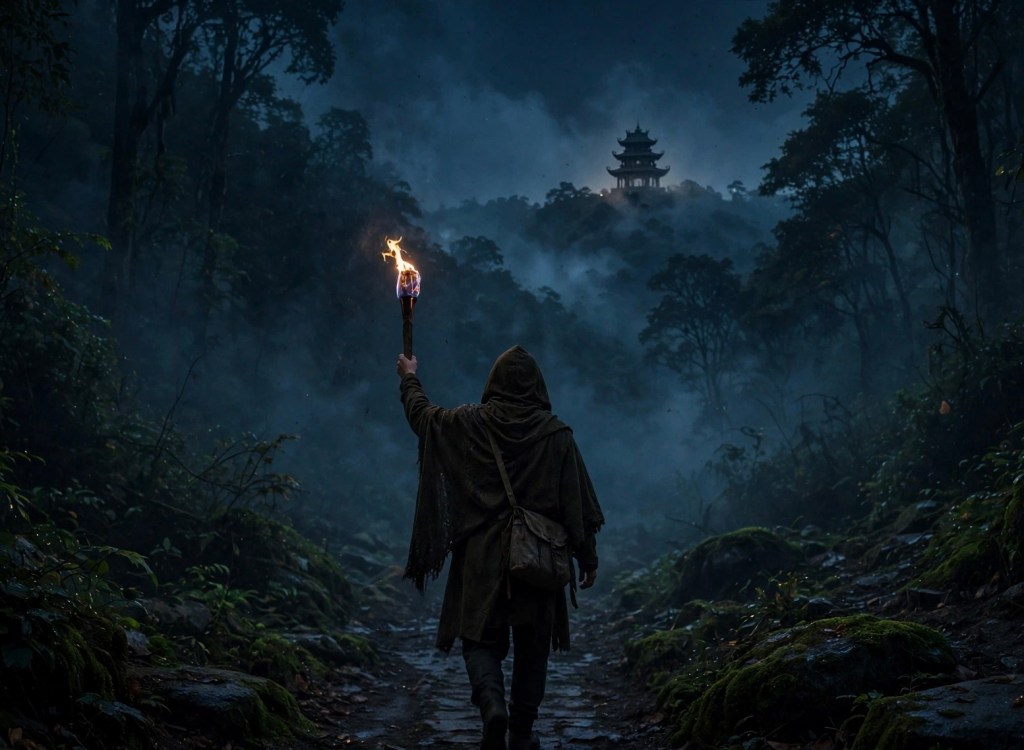
Walking with your own lamp, without becoming isolated or “unusual” among fellow practitioners
I. First clarity: “Be a lamp unto yourself” does not mean separating from the Sangha
Many people misunderstand the Buddha’s teachings:
• “Be a lamp unto yourself.”
• “Come and see.”
and assume they must:
• practice alone,
• not rely on anyone,
• avoid the Sangha,
• avoid teachers.
This is a misinterpretation.
“Be a lamp unto yourself” means:
Do not outsource your seeing to anyone else.
Do not let others decide truth for you.
Do not let methods, rituals, or scriptures replace direct experience.
But this does not contradict:
• practicing with the Sangha,
• learning from teachers,
• joining group activities,
• walking together in harmony.
Inner freedom is not isolation.
Lighting your own lamp is not rejecting the light of others.
—
II. How a lay practitioner avoids attachment to Dharma
1. Hold Dharma as a “means,” not a fixed truth
A method is a raft.
Not the shore.
When you see Dharma as a tool, you naturally:
• avoid arguing about correctness,
• avoid comparing traditions,
• avoid judging others,
• avoid clinging to scriptural language.
This is the spirit of non‑attachment.
2. Always return to direct experience
Whenever you hear teachings, chant, or practice, ask:
“Does this reduce my suffering?”
If yes → it is your Dharma.
If no → it is only words.
3. Do not let scriptural language replace your own insight
Scripture is a map.
Not the territory.
You may chant The Three Refuges, but do not let the words dictate how you see Dharma.
4. Do not let “closeness” become dependency
Closeness to the Sangha is beautiful.
Dependency on the Sangha is attachment.
You can:
• walk together,
• practice together,
• learn together,
but seeing must be done alone.
5. Maintain inner independence, not outer separation
You do not need to:
• leave the group,
• practice separately,
• behave differently.
You only need inner independence.
—
III. How to avoid being seen as “eccentric” while lighting your own lamp
1. Do not announce your independence
Eccentric people try to prove they are different.
A self‑lit practitioner simply sees, quietly.
2. Harmonize externally, be free internally
You can:
• chant with the group,
• sit with the group,
• walk with the group,
• join activities,
while internally:
• observing your mind,
• seeing directly,
• understanding quietly,
• transforming from within.
No one needs to know you are free.
And you do not need them to know.
3. Do not criticize others’ methods
Eccentric practitioners often:
• oppose tradition,
• criticize methods,
• say “I practice differently.”
A self‑lit practitioner:
• respects all methods,
• avoids comparison,
• avoids debate,
• avoids proving anything.
4. Do not reject the Sangha
You are free, but you still recognize:
• the Sangha stabilizes energy,
• the Sangha nourishes mindfulness,
• the Sangha prevents confusion.
You do not reject.
You simply do not cling.
—
IV. How to avoid being seen as “not close” to monastics
1. Be close through respect, not dependence
You still:
• respect teachers,
• learn from them,
• listen deeply,
but you do not:
• hand over your insight to them,
• let them decide truth for you,
• rely on them to walk for you.
2. Ask teachers to open doors, not to walk through them for you
You may ask:
• “What is your perspective?”
• “Can you offer another angle?”
But you do not ask:
• “Tell me what I must believe.”
• “Tell me how I must practice.”
3. Stay humble — this prevents misunderstanding
A self‑lit practitioner with arrogance → appears eccentric.
A self‑lit practitioner with humility → appears mature.
4. Do not oppose tradition
You are free, but you do not fight:
• rituals,
• chants,
• forms,
• customs.
You simply do not become trapped by them.
—
V. Summary: A lay practitioner walks with their own lamp through five principles
1. External harmony
No separation, no eccentric behavior.
2. Internal freedom
No outsourcing your insight.
3. Respect for methods without attachment to them
Methods are tools, not truth.
4. Respect for teachers without dependence
Teachers open doors; you walk through them.
5. Direct experience as the final authority
This is the essence of come and see.
—
VI. Conclusion: Walk with your own lamp — but walk among people, not in isolation
You can:
• walk with the Sangha,
• practice with the Sangha,
• chant with the Sangha,
• meditate with the Sangha,
while still:
• seeing for yourself,
• understanding for yourself,
• transforming for yourself,
• lighting your own lamp.
Not eccentric.
Not distant.
Not dependent.
Not attached.
This is the mature lay practitioner’s path —
free yet harmonious,
independent yet connected,
deep yet gentle.


Trả lời