Last night, during an online spiritual gathering, the song Đời Đá Vàng by Vũ Thành An was played.
I found myself wondering whether some people felt uncomfortable.
A song filled with longing, sorrow, and the burdens of the human condition might seem out of place in a setting devoted to spiritual practice.
To be honest, that was my first reaction as well.
But then another question quietly arose:
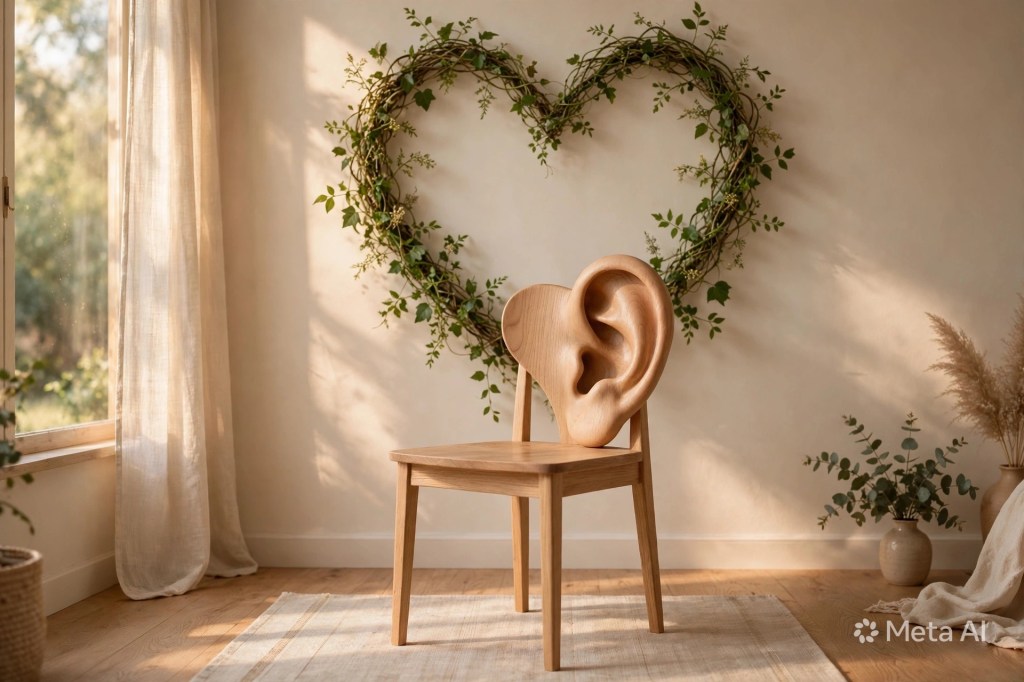
When the song was playing, was I listening like an Empty Chair?
Or was I listening through my opinions, preferences, expectations, and judgments?
As the music unfolded, different reactions naturally arose within different listeners.
Some may have felt deeply moved.
Some may have felt nostalgic.
Some may have thought it was inappropriate for a spiritual gathering.
Others may have heard within it an echo of the First and Second Noble Truths: suffering and its causes.
The song itself remained the same.
Yet each person heard something different.
Perhaps, then, the most interesting thing to observe was not the song.
Perhaps it was the mind listening to the song.
To listen like an Empty Chair does not mean we must like the song.
Nor does it mean we must agree with it.
It simply means creating enough inner space to observe whatever arises.
If discomfort appears, we quietly note:
“Discomfort is here.”
If a thought appears:
“This song should not be played during a Dharma gathering,”
we gently recognize:
“A thought has arisen.”
If an old memory surfaces with the melody, we acknowledge:
“Memory is here.”
If emotion arises, we know:
“Emotion is here.”
Nothing needs to be suppressed.
Nothing needs to be defended.
Nothing needs to be judged.
Only noticed.
This is, in fact, a very concrete mindfulness practice.
Breathing in, I know I am breathing in.
Breathing out, I know I am breathing out.
Then I return to observing my mind.
Not merely listening to the song.
But listening to how I am listening to the song.
Not merely hearing the lyrics.
But noticing the reactions unfolding within me.
Like sitting beside a river, watching leaves drift downstream.
The leaves are not the observer.
The river is not the observer.
They simply pass by.
Thoughts pass by.
Feelings pass by.
Agreement passes by.
Resistance passes by.
All of them move across the open sky of awareness.
At that point, the song is no longer an object of debate.
It becomes a mirror.
In that mirror, I may see my attachments, memories, preferences, judgments, and assumptions more clearly.
And perhaps the most important thing being listened to during that gathering is not the song itself.
But the mind that is listening to it.
I am beginning to understand that the Empty Chair in spiritual life is not a symbol of emotional numbness.
Quite the opposite.
It is a heart spacious enough to allow every feeling to arise without being carried away by it.
Quiet enough to hear a sad song without drowning in sadness.
Awake enough to notice resistance without becoming resistance itself.
Compassionate enough to offer every emotion a place to sit.
Yet wise enough not to hand over control.
🍂
So perhaps the real question after that gathering is not:
“Why was Đời Đá Vàng played?”
But rather:
“When Đời Đá Vàng was played, was I listening with the mind of an Empty Chair?”
For ultimately, spiritual practice does not begin with hearing only what we like.
It begins with recognizing whatever arises in our own mind with mindfulness, spaciousness, and freedom from judgment.
And perhaps it is in that very moment that the Empty Chair enters our spiritual life. 🌿
Perhaps, from this day forward, whenever something appears that does not match my expectations, a view different from my own, a song I would rather not hear, or an uneasy feeling in my heart, I may pause and quietly ask myself:“Am I reacting to this… or am I listening to it like an Empty Chair?”Perhaps that question itself is already a mindful step on the path.And perhaps the deepest wish behind The Empty Chair in Spiritual Life is not that it be remembered as an article, but that it become a living practice, a quiet space within the heart where every experience is first received with awareness rather than judgment.May all those who happen upon these words discover, within themselves, such an Empty Chair .
“Sit down. Don’t be quick to judge. Don’t be quick to fix things. Listen first.”


Trả lời