INTRODUCTION
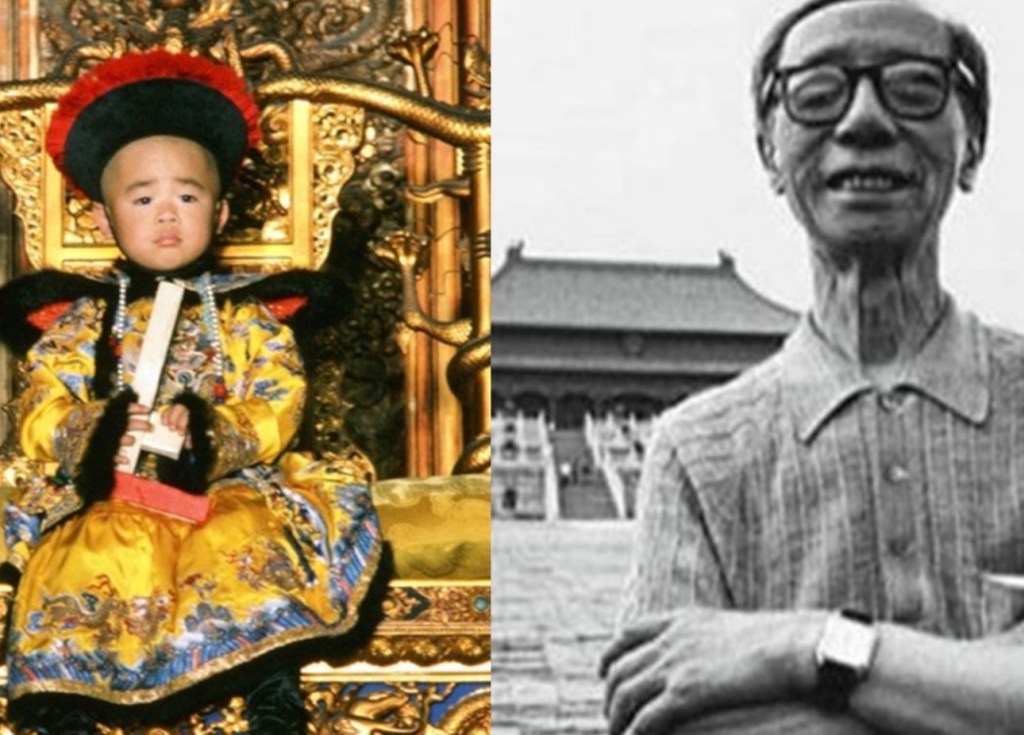
The story you are about to read is based on historical milestones in the life of Puyi — the last emperor of imperial China. However, the inner reflections, the moments of awakening, and the insights about blessings in each stage of his life are fictional and contemplative.
This is not Puyi’s autobiography.
This is not a historical biography.
This is not an interpretation of karma or past lives.
This is simply a work of literary historical fiction, in which Puyi’s life becomes a mirror to illuminate the meaning of blessings according to the spirit of the Discourse on True Blessings:
Blessings do not come from circumstances.
Blessings are the qualities of the mind in the present moment.
The contemplative insights in this story are imagined perspectives, intended to offer readers a clearer understanding of:
• inner blessings
• present‑moment peace
• the relationship between mind and circumstance
Here is the story I wish to share with you, drawn from the life of Puyi.
1. Born in the Imperial Palace (1906–1908)
Puyi opened his eyes under the golden glow of the palace.
People said he was “born with great blessings.”
But the child only knew he was taken from his mother and placed on a throne before he could speak.
In the sound of his own crying, he sensed something he would only understand much later:
A beautiful place cannot bring peace.
Only a peaceful mind can make a place beautiful.
2. A Puppet Emperor in the Forbidden City (1908–1924)
He lived among splendor, yet could not decide even a single breath of his own.
Every ritual was a gilded cage.
Every cheer was another chain.
He looked up at the towering red walls and wondered:
“Whose emperor am I, if I cannot even rule my own mind?”
And he understood:
Blessings are not about having much.
Blessings are the freedom from being bound by what we have.
3. Expelled from the Forbidden City (1924)
On his first night outside the palace, he saw a sky unblocked by golden roofs.
For the first time, he saw the sky as it truly was.
He thought:
“Only when I lose everything do I see what has always been here.”
A small spark of inner blessings flickered within him.
—
4. A Puppet for Japan (1932–1945)
He was placed on a throne again, this time in Manchukuo.
But this throne was even emptier than the first.
He realized:
A role repeated a thousand times
can never become one’s true self.
And he began to see that the idea of “power” was nothing more than a thin mist.
5. Imprisonment and Re‑education (1945–1959)
In the re‑education camp, he washed his own clothes, grew his own vegetables, cooked his own meals.
No attendants.
No flatterers.
No one who feared him.
Strangely, he felt lighter.
He smelled the fragrance of the earth.
He tasted the simple sweetness of a meal he cooked himself.
He understood:
Blessings are not being served.
Blessings are the ability to live wholeheartedly in each act.
For the first time, he experienced peace in the present moment.
6. A Street Sweeper — The Final Chapter (1959–1967)
In his final years, he swept fallen leaves in a Beijing park.
People pitied him:
• “An emperor reduced to sweeping the streets.”
But within him, these were his most peaceful days.
No throne.
No power.
No flattery.
No hatred.
Only him, the broom, and the earth.
A leaf drifted down.
He smiled:
“I was once a leaf on the highest branch.
Now I am a leaf on the ground.
But a leaf is a leaf, wherever it lies.”
And he understood what he had sought all his life:
Blessings are the way we stand within ourselves,
not the place we stand in the world.
LESSONS — A Zen Painting on Blessings
From Puyi’s life, we see clearly:
• Blessings do not lie in circumstances.
• Blessings are not wealth, power, or fame.
• Blessings are the qualities of the mind in the present moment.
• Blessings are the ability to remain unmoved by circumstances.
• Blessings are peace arising from within.
And ultimately:
When the mind is peaceful, every circumstance becomes a blessing.
When the mind is restless, every blessing becomes a burden.
Blessings do not come from the world outside,
but from the way we live within it.
(Tuesday, June 16, 2026 — after the NDCN class completed the Discourse on True Blessings)


Bình luận về bài viết này